Teaching fit: ages 13–18 with adult support · Plan for: two 45–60 minute sessions
You need: Scratch, GDevelop or Godot; one completed beginner game; a notebook. AI brainstorming is optional.
Finish line: An original prototype combining two rules, plus notes from a playtest.
A game mashup combines ideas about how a game plays. “Collect items + choose the right delivery order” is a useful starting point. A list of famous game titles is less helpful until you can explain which rules you mean. Invent your own title, characters, artwork and sounds; work from mechanics rather than importing another game’s identity.
STEP 01
Pick one main action and one twist.
- Collecting + sequence puzzle: gather three parcels and deliver them in a shown order.
- Maze + switches: moving through the maze changes which doors are open.
- Platforming + limited jumps: reach the exit with only three jumps.
- Rhythm + gardening: press a key in time to water a plant.
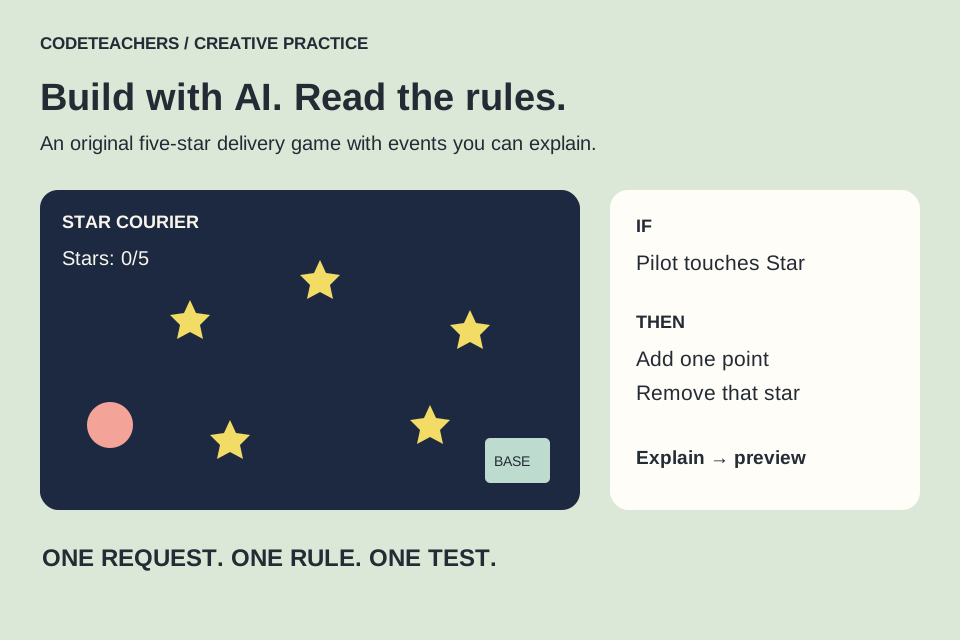
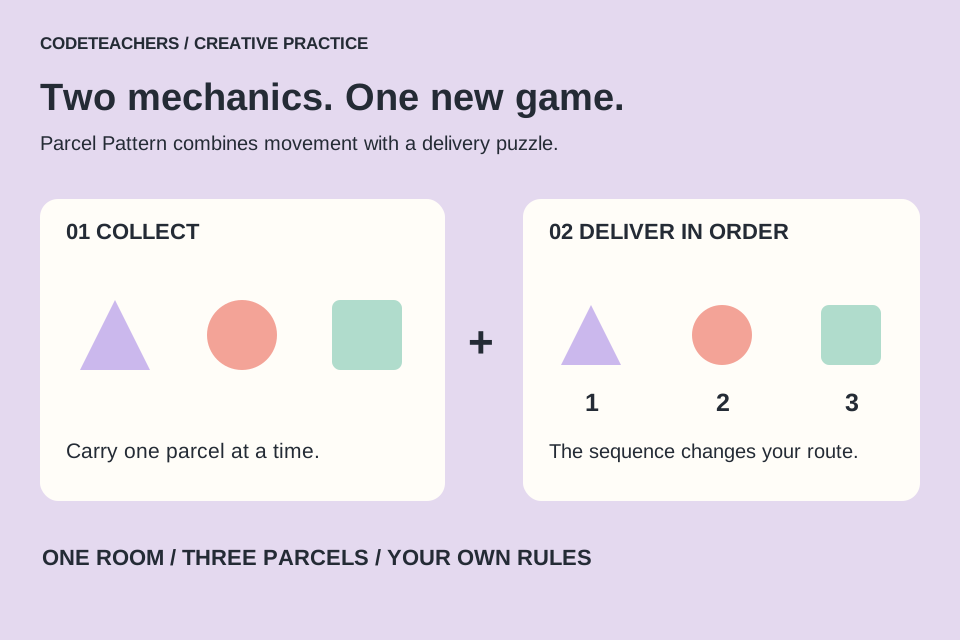
Choose just one pair. Our worked example, Parcel Pattern, combines a collector with an ordered-delivery puzzle. Start from Star Courier, or use a familiar Scratch project. A mashup is easier to judge when the basic movement already works.
STEP 02
Write a one-sentence promise.
Move around one room, carry one parcel at a time, and deliver
Triangle → Circle → Square in that order to complete the route.
Draw three parcels, one player and one depot. Give parcels both a shape and a label so the puzzle does not depend only on color. Show the complete order from the start. You are testing movement plus sequencing, not memory yet. Leave out enemies, inventory menus and extra levels.
If using an eligible assistant, ask for three possible twists and their tradeoffs. Pick one yourself. Useful constraint: “Keep one room, one player, three parcels and keyboard controls. Explain how each idea changes the player’s choices.”
STEP 03
Model the game on paper.
Write two state variables: Carrying starts as “none”; NextDelivery starts as 0. The required list is [triangle, circle, square]. Index 0 means the first item. Act out a round with paper tokens before writing events.
Touch a parcel while Carrying is none:
  set Carrying to that parcel’s type
  hide or remove that parcel from the floor

Touch Depot while carrying a parcel:
  if Carrying matches Required[NextDelivery]:
    advance NextDelivery by 1
    set Carrying to none
  otherwise:
    put that parcel back at its original position
    set Carrying to none
    show which shape is needed next

When NextDelivery equals 3:
  show success and stop accepting deliveries
This is pseudocode: a description to translate into your engine’s blocks, events or GDScript. Store each parcel’s starting position so returning a wrong parcel does not require guessing. Choose positions away from the depot.
STEP 04
Build the twist in small pieces.
First, implement carrying one parcel and display its shape name. Test that touching a second parcel cannot collect it while your hands are full. Next add the correct-delivery rule. Then add the wrong-delivery reset. Finally add victory and restart. Preview after every piece.
Prevent the depot event from repeating every frame by clearing Carrying as soon as you process a delivery. If using AI, request one of these changes at a time and ask it to name the events or scripts it changed. Keep a saved working version between requests.
STEP 05
Test both success and recovery.
- Correct order: all three deliveries complete the route exactly once.
- Wrong order: the parcel returns and the required item stays the same.
- Full hands: a second parcel stays on the floor.
- Empty hands at the depot: nothing changes.
- After victory: no extra delivery or score is accepted.
- Restart: all parcels, the order counter, held item and messages reset.
Ask a partner to play without coaching. Watch where they hesitate. Ask “What did you think would happen?” and “Which rule changed your plan?” Their behavior is more useful than a simple “Was it good?”
STEP 06
Keep the combination that earns its place.
If the sequence only causes extra walking, move the parcels or let the player choose between two routes. If nobody understands the order, improve the display before adding mechanics. Change one thing and replay. Keep the original version so you can compare.
Finish with a title, a controls card, a working restart and a short explanation of the two mechanics. Credit any permitted assets and AI assistance in your project notes. Adults and teachers can use the companion AI Teachers mashup workshop to facilitate the activity.